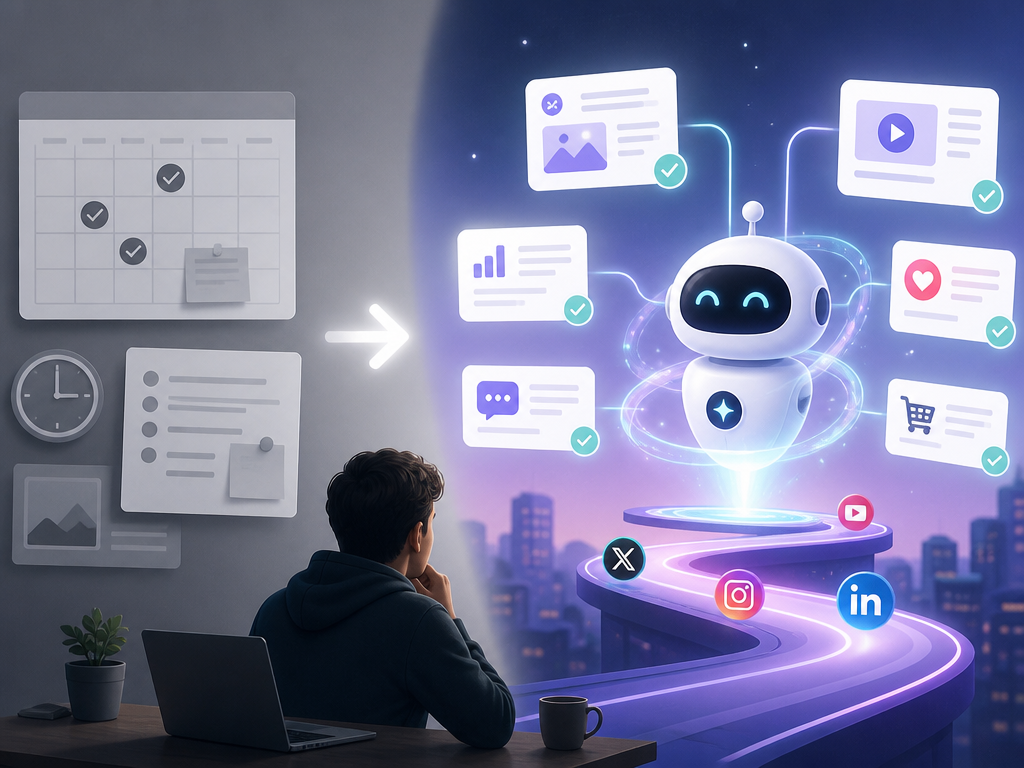
AI Social Media Agents vs. Traditional Schedulers: Which Tool Is Right for Your Business?
You're spending hours every week creating content, scheduling posts, and jumping between platforms. Your current scheduling tool helps — but you're still doing all the heavy lifting. Meanwhile, you keep hearing about AI social media agents that supposedly handle everything automatically.
So what's the real difference? And more importantly: which approach actually makes sense for your business right now?
Let's break down AI social media agents versus traditional schedulers — covering capabilities, costs, and the exact scenarios where each tool shines. By the end, you'll know exactly which category fits your workflow.
Understanding the Two Categories
Before we compare costs and features, let's clarify what we're actually talking about. These aren't just different brands — they're fundamentally different approaches to social media management.
What Traditional Schedulers Do
Traditional scheduling tools like Buffer, Hootsuite, and Later handle the distribution side of social media. You create your content elsewhere, then use these platforms to queue and publish across channels.
Core capabilities include:
- Calendar view for visualizing your posting schedule
- Bulk upload to queue multiple posts at once
- Cross-platform publishing to save time on manual posting
- Basic analytics showing engagement metrics
- Team collaboration features for approval workflows
The key limitation? You're still creating everything manually. Write the post in Google Docs, design the image in Canva, then paste into your scheduler. The tool handles timing and publishing — nothing more.
What AI Social Media Agents Actually Do
AI agents represent a category shift. Instead of just scheduling content you've created, they participate in the creation process itself using artificial intelligence.
These systems typically offer:
- AI content generation based on your brand voice and topics
- Autonomous scheduling that adapts to engagement patterns
- Multi-platform optimization creating platform-specific versions
- Continuous learning from your audience's response
- End-to-end automation from ideation through publishing
The fundamental difference: AI agents don't just move your content around. They help create it, optimize it, and continuously improve based on performance data.
The Cost Reality: Comparing Your Investment
Let's talk numbers. Cost is often the first consideration when evaluating tools — but the full picture includes your time investment, not just subscription fees.
Traditional Scheduler Pricing
Most traditional schedulers use tiered pricing based on connected accounts and team size:
- Entry tier: $15-30/month (3-5 social accounts, 1 user)
- Professional tier: $50-100/month (10+ accounts, basic analytics)
- Team tier: $200-400/month (collaboration features, advanced reporting)
That seems reasonable at first glance. But here's what these numbers don't include:
Your time cost. If you're spending 10 hours weekly on content creation and social management, that's 40+ hours monthly. At even a modest $50/hour valuation, you're investing $2,000 in time every month. Your $30 scheduler saves maybe 2-3 hours of that by handling publishing — still leaving you with 37 hours of manual work.
Additional tool costs. You'll likely need Canva ($12.99/month), Grammarly ($12/month), a link management tool ($10/month), and possibly ChatGPT Plus ($20/month) to help with content ideation. Now you're at $85/month in tools before counting your scheduler.
AI Agent Platform Pricing
AI-powered platforms typically price higher upfront but consolidate multiple capabilities:
- Starter plans: $29-79/month (AI content creation, basic automation)
- Professional plans: $99-199/month (full automation, multiple agents)
- Agency plans: $299-599/month (white-label, client management)
The price difference narrows considerably when you account for:
Eliminated tool stack. AI platforms typically include content creation, image generation, optimization, and scheduling in one subscription. You're replacing 3-5 separate tools.
Reduced time investment. If AI agents handle 60-70% of your content creation workflow, you're down from 10 hours weekly to 3-4 hours of review and approval. That's 24-28 hours saved monthly — worth $1,200-1,400 at $50/hour valuation.

Capability Comparison: What Each System Actually Does
Pricing tells part of the story. Capabilities determine whether a tool actually solves your problem. Let's compare what you get with each approach across key workflows.
Content Creation Process
Traditional schedulers: Zero assistance. You open a blank document and create everything from scratch. The scheduler is waiting on the other side to publish whatever you produce.
AI agents: Generate first drafts based on your inputs, brand guidelines, or content calendar. You provide direction ("Write a thread about productivity tips for developers") and review AI-generated options. This shifts your role from creator to editor — significantly faster for most people.
Winner for solo builders: AI agents save 5-7 hours weekly on initial content creation.
Platform Optimization
Traditional schedulers: You write one version, maybe manually customize for Twitter versus LinkedIn, then paste into the scheduler. Most people skip customization due to time constraints and post identical content everywhere.
AI agents: Automatically create platform-specific versions. Your core message gets reformatted for Twitter threads, LinkedIn posts, Instagram captions — each optimized for that platform's format and audience expectations.
Winner for cross-platform presence: AI agents maintain consistent messaging while respecting platform differences.
Scheduling Intelligence
Traditional schedulers: You pick time slots (maybe using their "optimal time" suggestions based on general data). The tool publishes at exactly those times, every week, regardless of what's actually happening with your audience.
AI agents: Analyze your specific audience engagement patterns and adapt. If your Tuesday posts consistently outperform Wednesday, the system learns and adjusts. Some platforms even pause posting during low-engagement periods and increase frequency during high-attention windows.
Winner for engagement optimization: AI agents continuously improve timing based on your data.
Visual Content Handling
Traditional schedulers: Upload images you've created elsewhere. Some offer basic editing or integration with Canva, but you're still designing visuals manually.
AI agents: Many now include AI image generation or smart template systems that create on-brand visuals automatically. Quality varies by platform, but the capability exists within the same tool.
Winner for visual efficiency: AI agents reduce tool-switching and manual design work.
Performance Analysis and Iteration
Traditional schedulers: Show you analytics dashboards with engagement metrics. You review the data and manually adjust your strategy based on what you observe.
AI agents: Use performance data to automatically adjust content strategy. Low-performing content types get deprioritized, high-performers get amplified. The system learns what resonates with your specific audience.
Winner for continuous improvement: AI agents close the feedback loop automatically.
When Traditional Schedulers Still Make Sense
AI agents aren't universally better for every situation. Traditional schedulers remain the right choice in specific scenarios — and knowing when you fit those scenarios saves money and frustration.
You Have Existing Content Creation Systems
If you've already built efficient content creation workflows and genuinely enjoy the creative process, schedulers might be all you need. Content creators who batch-record videos, professional writers with editorial calendars, or visual artists creating original graphics often don't want AI involvement in creation.
Traditional schedulers serve these workflows perfectly — you're optimized on the creation side and just need reliable distribution.
You're Publishing Infrequently
Posting 2-3 times weekly across a single platform? The time savings from AI agents matter less at low volume. A simple scheduler handles your needs without adding capabilities you won't use.
The ROI calculation shifts dramatically at higher volumes. Once you're targeting daily posts across multiple platforms, AI assistance becomes increasingly valuable.
You Need Maximum Manual Control
Certain industries require extensive compliance review, legal approval, or brand consistency checks. If every single word needs human verification before publishing, AI generation might add process steps rather than removing them.
However, even in regulated industries, AI agents can draft initial content for review — you're still making final decisions, just starting from a drafted baseline instead of blank pages.
Budget Is Your Primary Constraint
If you're genuinely limited to $20-30/month and can't increase budget regardless of time savings, entry-level traditional schedulers provide basic functionality at that price point.
Just remember to factor in your time. Many solo builders discover that investing $50-100 more monthly saves enough hours to actually grow their business — making the higher subscription cost neutral or positive from a business perspective.
When AI Agents Become Essential
Conversely, certain situations make AI agents not just beneficial but practically necessary for sustainable growth.
You're Managing Multiple Platforms
Active presence on Twitter, LinkedIn, Instagram, and Facebook means 20-30+ posts weekly if you're posting daily per platform. Creating that volume manually while maintaining quality becomes unsustainable fast.
AI agents let you set strategy and approve content rather than manually writing every single post. This is exactly why we built Agent Mio — autonomous AI agents handle drafting across all your channels while you focus on approval and strategic direction.
Content Creation Is Your Bottleneck
If posting consistency suffers because you struggle to generate ideas or write posts, AI agents directly solve your constraint. The technology excels at ideation and first-draft creation — exactly where many builders get stuck.
You're not replacing your voice or expertise. You're using AI to translate your knowledge into consistent content output without the blank-page paralysis.
You're Scaling to an Agency Model
Managing social media for multiple clients multiplies every challenge. Traditional schedulers help with organization, but you're still manually creating content for each client.
AI agents with multi-account management let you set brand guidelines per client, then generate appropriate content for each. Review time becomes your main investment rather than creation time — crucial when managing 5, 10, or 20 client accounts.
You Value Time Over Money
Solo founders and builders often have more financial resources than time. If an extra $50-100 monthly saves 15-20 hours, that's one of the highest-ROI investments available.
Those reclaimed hours go toward product development, customer conversations, or actual business growth — activities that matter far more than crafting individual social posts.
Making the Transition: Migration Strategies
Convinced that AI agents fit your needs? Here's how to transition smoothly without disrupting your existing social presence.
Start With One Platform
Don't immediately automate everything. Pick your secondary platform (not your primary audience channel) and test AI-generated content there first. This gives you experience with the technology while minimizing risk to your core audience.
Monitor engagement for 2-3 weeks. Compare performance to your manually-created posts. Adjust AI parameters based on what you observe.
Develop Your Review Process
Establish clear approval workflows before going fully autonomous. Most AI agent platforms let you review and edit before publishing — take advantage of this during your learning phase.
Set daily review times (15-20 minutes) to approve upcoming posts. You're still controlling what publishes, just starting from AI drafts instead of blank pages.
Maintain Your Brand Voice
Feed the AI examples of your best-performing content. Most platforms learn from your writing style, topic preferences, and audience engagement patterns.
The more you refine and provide feedback, the better AI agents match your authentic voice. Think of it as training an assistant rather than replacing yourself.
Keep Your Scheduler Running (Temporarily)
During transition, run both systems in parallel for 2-4 weeks. Use your traditional scheduler for critical announcements and time-sensitive content while testing AI agents for regular posting.
This redundancy provides safety while you build confidence in the new system.
The Hybrid Approach: Best of Both Worlds
You're not forced to choose exclusively between traditional schedulers and AI agents. Many successful builders use a hybrid strategy that leverages both technologies.
AI for Regular Content, Manual for Key Messages
Let AI agents handle your consistent posting schedule — daily tips, industry insights, engagement content. Personally craft major announcements, product launches, or thought leadership pieces.
This balances automation efficiency with strategic control where it matters most.
Different Tools for Different Platforms
Some platforms suit AI generation better than others. Twitter threads and LinkedIn posts adapt well to AI assistance. Instagram Stories or TikTok content might need more manual creative input.
Use AI agents where they excel, traditional scheduling where human creativity dominates.
Seasonal Adjustment
Lean heavily on AI during intense work periods (product launches, client projects, busy seasons). Scale back to more manual creation when you have bandwidth for hands-on content work.
Flexibility matters more than rigid adherence to one approach.
The Real Question: What's Your Time Worth?
Ultimately, choosing between traditional schedulers and AI agents isn't about features or pricing tiers. It's about how you value your time and what role social media plays in your business strategy.
If social media is your core business — you're a creator, influencer, or social media manager — you might enjoy the manual creation process. Traditional schedulers support your workflow without changing what you love about content creation.
If social media is a growth channel for your product, service, or agency — and you'd rather spend time building than posting — AI agents become powerful force multipliers. They handle the consistent execution while you focus on strategy and business development.
Calculate your current monthly investment: tool costs plus hourly time at your actual business value. Compare that to AI agent pricing plus reduced time commitment. The math usually clarifies the decision quickly.
Your Next Steps
You now understand the fundamental differences between traditional schedulers and AI social media agents — along with the scenarios where each approach makes sense.
Here's how to move forward based on your situation:
If you're spending 8+ hours weekly on social media and managing multiple platforms, AI agents will likely save significant time. Start with a free trial to test content quality and workflow fit.
If you're posting infrequently on a single platform and enjoying your current creation process, stick with your traditional scheduler. You're not the target use case for AI agents yet.
If you're unsure about content quality, run a hybrid approach for one month. Let AI handle 70% of posts while you manually create 30%. Compare engagement metrics to validate quality.
If you're ready to reclaim 10+ hours weekly and eliminate the content creation bottleneck that's limiting your social consistency, try Agent Mio free. Our AI agents learn your brand voice, create platform-optimized content, and handle scheduling across all your channels — you just review and approve.
The future of social media management isn't about working harder. It's about working smarter with AI handling execution while you focus on growth strategy. Your content doesn't suffer — your time constraints do.
Ready to automate your social media workflow? Start your free Agent Mio trial and see what 10 extra hours per week feels like.
#AgentMio #AIContentCreation #SocialMediaManagement #BuilderTools #AIAutomation #SoloBuilder #ContentMarketing #GrowthHacking