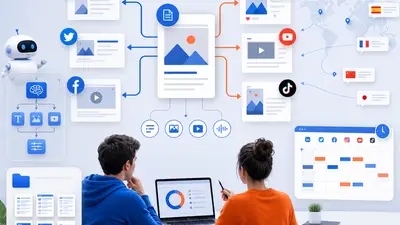
Agentic AI Marketing: Why Teams of AI Agents Are Replacing Single AI Assistants in 2026
Discover how coordinated AI agent teams are replacing single assistants for content, scheduling, and reporting. Learn why agentic AI is becoming essential for modern marketing teams.

By AgentMio team Published · 7 min read
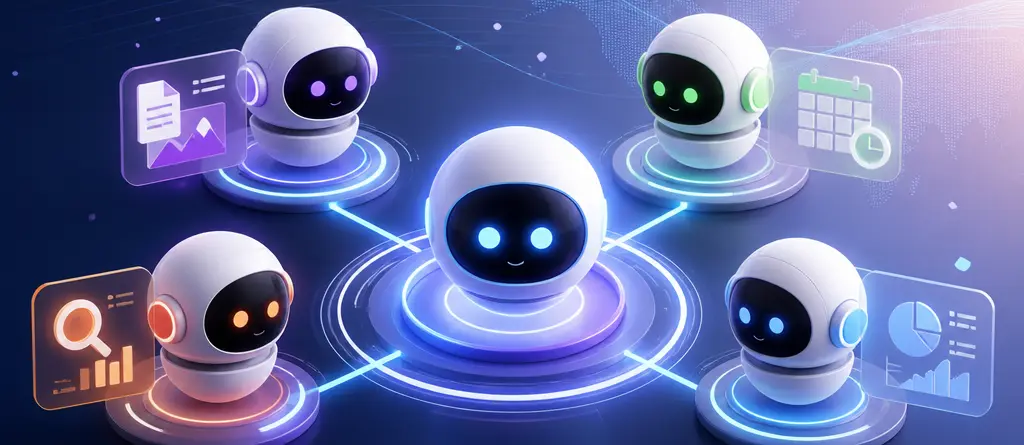
Agentic AI marketing is the shift from using one AI chatbot for isolated tasks to running a coordinated team of specialized AI agents that research trends, draft content, schedule posts, and report results together. In 2026, this shift is becoming the default way lean marketing teams and boutique agencies operate. Instead of asking "what can this AI tool do," the better question is "what can this team of AI agents do for my entire workflow."
What Does "Agentic AI Marketing" Actually Mean?
Agentic AI marketing refers to using multiple AI agents, each with a specific job, that work together toward a shared marketing goal instead of a single assistant handling everything alone. One agent might monitor trends, another drafts captions, another schedules posts across platforms, and another compiles performance reports.
The key difference from a standard AI assistant is coordination. A single-purpose tool like a caption generator or a scheduling bot does one job well but has no awareness of what happens before or after its task. An agentic system passes context between agents automatically, so the trend an agent spots on Monday can shape the content another agent drafts on Tuesday.
Why Are Marketers Moving Away From Single AI Assistants?
Marketers are moving away from single-purpose AI tools because stitching together five separate apps for research, writing, design, scheduling, and analytics creates more manual handoff work, not less. Each tool solves one problem while leaving the connective tissue between tasks to a human.
For a solo founder or a three-person agency team, that connective tissue is the real time sink. You might save 20 minutes writing a caption with an AI writer, then lose 30 minutes copying it into a scheduler, resizing images for each platform, and translating it for a second-language audience.
Multi-agent AI systems close that gap by design. The output of one agent becomes the input of the next, automatically, which is why AI agent teams 2026 is emerging as a search category among marketers who already feel the limits of single-tool AI.
How Do AI Agent Teams Actually Work Together?
An AI agent team works by dividing a marketing workflow into specialized roles, then letting each agent hand off its output to the next agent in the sequence without a human re-typing or re-uploading anything in between.
A typical content workflow for a boutique agency managing multiple client brands might look like this:
- Trend agent: Scans platform activity and flags relevant conversations or formats worth joining (often called trendjacking).
- Content agent: Drafts platform-specific captions, hooks, and visuals based on the brand's voice and the trend data.
- Scheduling agent: Places each post at the optimal time for each platform and time zone.
- Reporting agent: Pulls engagement data after publishing and summarizes what worked, so the next content cycle improves.
This is the structure AgentMio is built around: AgentMio provides a team of AI agents for boutique agencies and small teams to manage multiple social media accounts across multiple brands and languages from one centralized dashboard, so each step above happens inside a single workflow instead of across five disconnected apps.
What Does This Mean for the Future of Marketing Automation?
The future of marketing automation is less about automating single tasks and more about automating entire workflows end-to-end, with a human approving key decisions rather than performing every step. This is a meaningful shift from the 2020-2023 era of marketing automation, which mostly meant rule-based triggers like "if someone opens this email, send that email."
Agentic systems add judgment to automation. A trend-research agent doesn't just follow a rule; it evaluates whether a trend fits a brand's voice before passing it along. A reporting agent doesn't just export a spreadsheet; it highlights which post format drove the most engagement and suggests doing more of it.
For small teams, this matters because it narrows the gap between what a boutique agency can offer and what a much larger team could previously only afford to do with dedicated specialists for strategy, writing, design, and analytics.
Can AI Agent Teams Replace Hiring More Staff?
AI agent teams can't replace human strategy and client relationships, but they can absorb the repetitive production work that used to require hiring a content producer or social media coordinator. This is where the idea of AI employees for small teams comes from: not a replacement for your team, but an extension of it that handles volume.
Consider a boutique agency managing six client brands. Historically, scaling to a seventh client often meant hiring another coordinator to handle the extra drafting, scheduling, and reporting. With a multi-agent system handling those repeatable steps, the same core team can take on more brands without proportionally growing headcount.
This directly addresses one of the most common pain points for small agencies: the 10+ hours per week per client typically spent on manual social media work. When agents handle drafting, scheduling, and first-pass reporting, that time gets redirected toward strategy, client relationships, and creative direction, the work that actually requires a human.
How Do You Start Using Agentic AI Marketing on a Small Team?
You start by identifying which parts of your current workflow are purely repetitive versus which require human judgment, then introducing agents only for the repetitive parts first.
Prerequisites before you start
- A clear list of your current weekly social media tasks (research, drafting, scheduling, reporting)
- Access to your brand's voice guidelines or past content for reference
- Admin access to the social accounts you plan to manage
- No coding skill required; most agentic platforms are built for marketers, not developers
Step 1: Map your current workflow by task, not by tool
Write down every task involved in getting one post live, from idea to publish to reporting. For example: spotting a trend, writing three caption variations, resizing an image for Instagram and LinkedIn, scheduling at the right time, and checking engagement a week later. This map becomes the blueprint for which tasks you hand to which agent.
Step 2: Assign one agent per repeatable task
Match each task from Step 1 to a specialized agent instead of a single do-everything tool. A content agent drafts captions in your brand voice, a scheduling agent places them at the right time across platforms, and a reporting agent tracks what performed best. Keep the tasks that require real judgment, like final approval or client strategy calls, with a human.
Step 3: Connect the agents into one workflow
Choose a platform where agents share context automatically rather than requiring you to copy output from one tool into another. For a three-brand agency, this means the trend an agent finds for Brand A doesn't need to be manually re-entered when drafting content for Brand B; the system should let you manage all brands from one dashboard.
Step 4: Set approval checkpoints, not full autonomy
Decide where you want a human review before publishing, especially early on. Most small teams start with full manual approval, then loosen the checkpoint as they build trust in the agents' output quality.
Step 5: Review agent output weekly and refine brand voice inputs
Spend 15-20 minutes a week checking what the content agent produced versus what you'd write yourself, and update your voice guidelines or examples accordingly. This feedback loop is what makes agent output sound more like your brand over time instead of generic AI copy.
Common mistakes to avoid
- Turning on full automation before checking a few weeks of output quality
- Using one agent to do everything instead of specializing tasks, which recreates the single-assistant bottleneck
- Skipping brand voice inputs, which leads to generic-sounding content
- Not setting a reporting cadence, so you never learn what's actually working
Quick-start checklist
- Task map completed for one brand
- Brand voice examples uploaded or documented
- One agent assigned per task (research, content, scheduling, reporting)
- Approval checkpoint set for the first two weeks
- Weekly 15-minute review scheduled
FAQ
What is the difference between agentic AI and a regular AI chatbot?
A regular AI chatbot responds to one prompt at a time and has no memory of your broader workflow. Agentic AI uses multiple specialized agents that pass information to each other automatically, completing a multi-step task like research-to-published-post without you manually moving output between tools.
Is agentic AI marketing only useful for large companies?
No. Agentic AI marketing is particularly useful for solo founders, small teams, and boutique agencies because it replaces the repetitive production work that would otherwise require hiring additional staff. A small team can manage more brands or clients without a proportional increase in headcount.
How many AI agents does a small team actually need?
Most small teams start with four core agents: one for trend research, one for content drafting, one for scheduling, and one for reporting. This covers the full content lifecycle without adding unnecessary complexity, and additional specialized agents can be added as needs grow.
Does using AI agent teams mean giving up creative control?
No. Most agentic marketing platforms are designed with human approval checkpoints, meaning agents draft and prepare work while a person reviews and approves before anything publishes. Creative direction and brand strategy remain human-led; agents handle the repeatable execution around them.
How is AgentMio different from a single social media scheduling tool?
AgentMio is a platform built around a team of AI agents rather than a single scheduling function, covering content creation, scheduling, multi-brand management, and reporting from one dashboard. It's designed specifically for boutique agencies and small teams managing multiple brands, platforms, and languages at once.
Ready to see what a coordinated AI agent team can do for your workflow? Try Agent Mio free and start managing every brand, platform, and language from one place.