Managing Multiple Brand Voices Without Losing Your Mind: A Real-World Case Study
Master the art of juggling multiple client brand voices without confusion. Learn proven strategies for voice documentation, AI prompts, and approval workflows that keep your team sane.

By AgentMio team Published · Updated · 5 min read
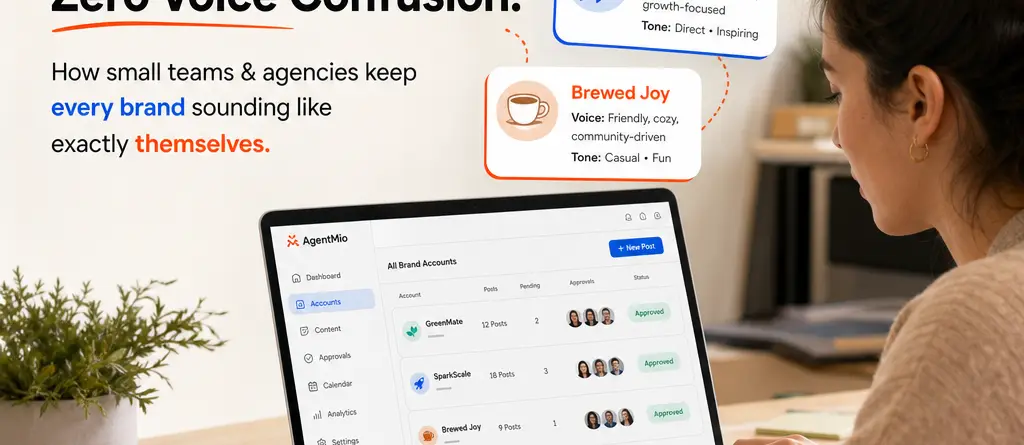
You're managing social media for three different clients. One's a playful fitness brand, another's a serious B2B SaaS, and the third is a wellness coach with a warm, personal vibe. Your team is just you and maybe one other person. How do you keep all those voices straight without accidentally posting your client's Instagram meme to their LinkedIn page?
This isn't a theoretical problem. It's the daily reality for small agencies and multi-brand managers everywhere. Let's break down exactly how to maintain distinct brand voices across multiple accounts — without burning out or creating expensive mistakes.
The Multi-Brand Management Challenge
When you're juggling multiple brand accounts, three things typically go wrong:
- Voice bleed: Brand A's casual tone accidentally shows up in Brand B's formal content
- Context overload: Switching between different personalities throughout the day creates mental fatigue
- Approval bottlenecks: Each brand needs review, but you're drowning in drafts and approval requests
A recent survey found that social media managers handling 3+ brands spend 60% of their time just switching contexts and finding the right voice. That's not creating content — that's just trying to remember who sounds like what.
Real Case Study: How a 3-Person Agency Manages 8 Brand Accounts
Meet Sarah's team at Spark Social, a boutique agency in Austin. Three people, eight client accounts, posting 5-7 times per week per brand. That's 40+ posts weekly. In 2023, they were drowning — working nights and weekends just to keep up.
Here's what changed when they implemented a systematic approach to multi-brand voice management:
Step 1: Create Living Voice Documents
Sarah started by documenting each brand's voice in a way AI could actually use. Not vague mood boards — specific, actionable guidelines.
For each brand, they documented:
- Three descriptive voice attributes (example: "conversational, data-driven, encouraging")
- Five "always use" phrases and five "never use" phrases
- Typical sentence structure (short and punchy vs. longer and explanatory)
- Emoji usage rules (frequency, types, placement)
- Hashtag strategy (branded, industry, trending mix)
- Call-to-action patterns unique to that brand
Example voice doc excerpt for fitness brand "FlexFlow":
"Keep it energetic and motivational. Use action verbs. Sentence length: 8-12 words average. Always emojis: 💪 🔥 ✨. Never: corporate speak, long paragraphs, 'leverage' or 'synergy'. CTA style: Direct challenges like 'Try this today' or 'Your move 👇'"
Step 2: Engineer Brand-Specific AI Prompts
Here's where it gets powerful. Sarah's team didn't just tell AI "write in Brand X's voice" — they created templated prompts that embedded the voice guidelines directly.
Their prompt structure:
- Brand context: "You're creating content for [Brand], a [description]"
- Voice rules: Insert the documented attributes, always/never phrases
- Content parameters: Platform, format, topic, length
- Quality check: "Review for [specific voice elements] before output"
This is exactly why we built Agent Mio — AI agents that remember each brand's voice parameters automatically. Sarah's team sets up voice profiles once, and the AI maintains consistency across every post without manual prompt engineering each time.
Step 3: Build Smart Approval Workflows
The bottleneck wasn't just creation — it was approval. Eight clients meant eight approval chains.
What worked:
- Batch by brand day: Monday for Brand A, Tuesday for Brand B, etc.
- Weekly approval windows: Clients review a week's content in one sitting
- Tiered urgency: Evergreen content goes through full review, timely content gets fast-track approval
- Templates for common content types: Pre-approved formats speed up review
Sarah's team reduced approval time from 3-4 days to under 24 hours by implementing structured review cycles. Clients actually preferred the predictability.
Step 4: Create Context-Switching Rituals
Mental fatigue from switching between brand voices is real. Sarah's solution: deliberate transition rituals.
Before creating content for a new brand:
- Review the last 3 posts from that brand (60 seconds)
- Read the voice doc opening (30 seconds)
- Speak 2-3 example sentences in that brand's voice out loud (yes, really)
This 2-minute reset dramatically reduced voice bleed. Your brain needs a clear signal that you're switching contexts — give it one.
The Results: Real Numbers
After three months of implementing this system:
- Time savings: 12 hours per week recovered (from 50+ hours to 38 hours for all eight brands)
- Consistency scores: Client feedback on "staying on-brand" improved 40%
- Revision requests: Dropped from 3.2 per post to 0.8 per post
- Team capacity: Added two more clients without additional hiring
Your Multi-Brand Management Checklist
Ready to implement this system? Start here:
This Week:
- Document voice guidelines for your top 2 brands using the framework above
- Test AI-generated content for both — compare against manual drafts
- Set up one batch approval day with your most collaborative client
This Month:
- Complete voice documentation for all active brands
- Establish brand-specific AI prompts or profiles
- Implement structured approval workflows across all clients
- Track time spent per brand before and after process changes
This Quarter:
- Audit voice consistency across past 30 days of content per brand
- Refine voice docs based on client feedback patterns
- Evaluate capacity for additional brand accounts
The Centralized Management Advantage
The counterintuitive truth: centralized tools actually make maintaining distinct voices easier — when done right. You're not logging into eight different platforms. You're not losing context. You're not recreating processes for each brand.
You're in one place, with all your voice guidelines accessible, all your content organized by brand, all your approvals flowing through predictable workflows.
Agent Mio handles exactly this scenario. Set up each brand's voice profile, create content through AI agents that remember those profiles, route approvals to the right stakeholders, and ship to the right channels — all without leaving the platform. No voice confusion, no platform juggling, no context chaos.
Final Thoughts
Managing multiple brand voices isn't about being a vocal chameleon who can instantly shift personalities. It's about building systems that do the heavy lifting — documented guidelines, AI assistance that maintains consistency, and workflows that prevent bottlenecks.
Sarah's agency didn't hire more people. They built better processes. You can too.
Ready to centralize your multi-brand management without sacrificing voice consistency? Try Agent Mio free → Start automating your content workflow
#AgentMio #SocialMediaManagement #ContentMarketing #AIContentCreation #BuilderTools #AgencyTools #AIAutomation #GrowthHacking