Social Listening for Small Business: A No-Budget Guide for Agencies and Solo Builders
Learn how small agencies and solo builders can set up social listening with free tools. Discover which keywords to track, how to turn mentions into content and client insights, and how to spot crises early.

By AgentMio team Published · 7 min read
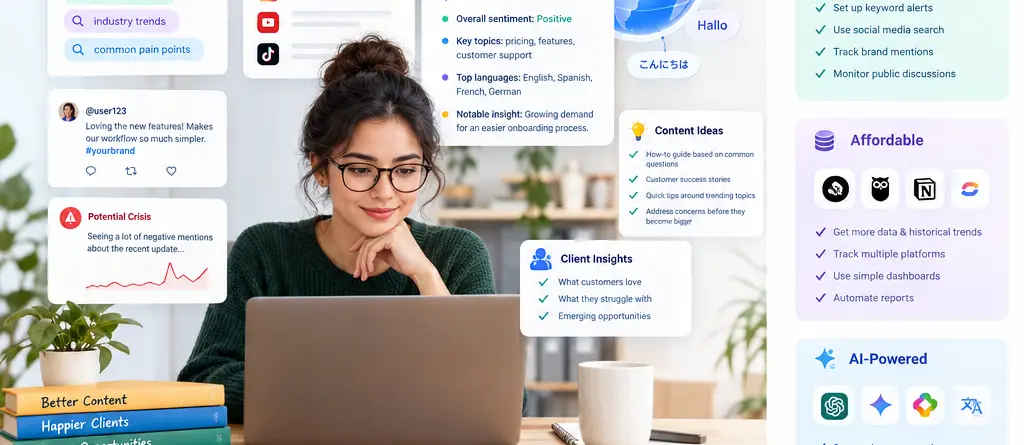
Social listening for small business means tracking brand mentions, keywords, and conversations across social platforms to spot opportunities and problems early. You don't need enterprise software to do it — a few free tools, a clear keyword list, and a weekly routine can get you 80% of the value. This guide shows you exactly which keywords to track, how to turn findings into content and client reports, and how AI can summarize conversations across brands and languages in minutes.
What Is Social Listening, Exactly?
Social listening is the practice of monitoring social media platforms, review sites, and forums for mentions of your brand, your competitors, and topics relevant to your industry — then analyzing that data to inform decisions. It's different from basic social monitoring, which just tracks mentions; listening goes a step further by looking for patterns, sentiment, and themes you can act on.
For a boutique agency, this means tracking conversations for every client brand you manage. For a solo founder, it means tracking your own name, product, and niche. Either way, the goal is the same: catch what people are saying before it becomes a missed opportunity or an unmanaged crisis.
Why Does Social Listening Matter for Small Teams?
Small teams and solo builders often skip social listening because it sounds like a job for a dedicated analytics department. In reality, the cost of skipping it is higher than the cost of doing it badly.
Missed content ideas: Customers are already telling you what they want to know — you just aren't watching.
Slow crisis response: A negative thread can gain traction for hours before a small team even notices.
Weak client reporting: Agencies that can show a client "here's what people are saying about you" build more trust than agencies that only report post counts and likes.
Competitive blind spots: Without tracking competitor mentions, you won't know when a rival launches something that shifts the conversation in your niche.
None of this requires a big budget. It requires a system.
Which Keywords and Mentions Should You Track?
Start with a short list rather than trying to track everything — a focused list you actually check beats a long list you ignore. Build your tracking list around four categories.
Brand terms: Your business name, product names, founder names, and common misspellings.
Branded hashtags and handles: Any hashtag you promote, plus @mentions and un-tagged mentions (people often forget to tag you).
Competitor names: Track 2-4 direct competitors so you can spot shifts in sentiment or feature complaints you can address.
Industry and problem keywords: Phrases your ideal customer types when they have the problem you solve — for example, "best scheduling tool for agencies" or "how to post to Instagram and TikTok at once."
This is brand mention monitoring at its simplest: a short, specific list, checked on a regular cadence, rather than a vague attempt to watch "everything."
How Do You Do Social Listening Without Enterprise Tools?
You can run effective social listening for agencies and solo brands using a mix of free native tools and a few affordable add-ons. Here's a realistic, budget-aware stack.
Free and Native Options
Platform search and alerts: X (Twitter) search, Instagram hashtag search, and LinkedIn search let you manually check mentions daily at no cost.
Google Alerts: Free and simple for tracking brand names across news sites and blogs, though it misses most social conversation.
Reddit and niche forum search: Many small-business conversations happen in subreddits and niche communities — searching your brand or product name there is free and often reveals unfiltered feedback.
Native platform analytics: Instagram, TikTok, and LinkedIn all show comment and mention activity inside their built-in insights, at no added cost.
Affordable Add-On Tools
When free tools start taking too much manual checking, affordable listening add-ons can automate keyword alerts and basic sentiment tagging for a modest monthly fee. Look for tools that let you set multiple keyword streams, export reports for clients, and filter by language if you work with international brands.
ApproachCostBest forManual platform searchFreeSolo builders, single brandGoogle Alerts + native analyticsFreePress mentions, basic trackingAffordable listening add-onsLow monthly feeAgencies tracking multiple keywordsAI-powered multi-brand platformStarts free, scales with useAgencies managing several clients/languages
The key is matching the tool to how many brands and languages you actually manage — not buying more than you need.
How Do You Turn Listening Data into Content Ideas?
Raw mentions are only useful once you convert them into something actionable. Build a simple weekly habit: read your tracked mentions, then sort them into three buckets.
Questions people keep asking — turn these directly into how-to posts, captions, or FAQ content.
Complaints about competitors — these point to gaps you can highlight in your own content without naming names.
Unexpected praise or use cases — customers often use your product in ways you didn't plan for; these make great case-study or testimonial content.
For agencies, this same bucket system doubles as client reporting. Instead of a generic monthly recap, you can show a client exactly which questions their audience is asking and which content ideas came directly from real conversations.
How Do You Spot a Social Media Crisis Early?
A social media crisis is a sudden spike in negative mentions, shares, or comments about a brand that risks spreading faster than the team can respond. Catching it early is almost entirely about frequency of checking, not the sophistication of your tools.
Set a daily check-in for brand mentions, even just five minutes, rather than relying on weekly reviews.
Watch for spikes, not just volume — three negative comments in one hour is more urgent than thirty spread across a week.
Track sentiment shifts on competitor mentions too — sometimes a crisis in your industry (a competitor's data breach, a viral complaint about a shared supplier) spills over into your own mentions.
Have a response template ready before you need it, so your team isn't drafting a reply from scratch during a stressful moment.
Small teams and solo builders often assume crises only happen to big brands. In practice, smaller accounts can be hit just as hard because they have fewer people watching and reacting.
How Can AI Help with Social Listening Across Brands and Languages?
AI can summarize large volumes of comments, mentions, and messages into a short digest, which saves the hours it would take to read everything manually. For agencies managing multiple client brands, this matters even more — the manual-reading problem multiplies with every brand and every language you add.
This is exactly why we built AgentMio — AI agents that help boutique agencies and small teams manage multiple social media accounts across multiple brands and languages from one centralized dashboard. Instead of switching between tools and tabs per client, you can review AI-summarized activity and content drafts in one place, then approve what ships.
AgentMio is an AI-powered social media management platform built for agencies and small teams that need to run several brands, platforms, and languages without hiring a bigger team. For an agency juggling five client accounts in three languages, that kind of centralized, AI-assisted summary turns hours of reading into minutes of review.
Building a Simple Weekly Social Listening Routine
Consistency beats sophistication when it comes to how to do social listening well on a small budget. A simple weekly routine looks like this:
Monday: Check brand and competitor mentions from the weekend, flag anything urgent.
Wednesday: Pull 2-3 recurring questions or complaints into a content idea list.
Friday: Summarize the week's findings for the client or for your own content calendar.
Agencies can repeat this routine per brand, or use an AI summary to compress the reading time across all client accounts into a single sitting.
FAQ
What's the difference between social listening and social monitoring?
Social monitoring tracks individual mentions of your brand as they happen, similar to a notification feed. Social listening takes those mentions and looks for patterns, themes, and sentiment over time so you can make decisions — like which content to create or how to respond to a recurring complaint.
Can I do social listening for free?
Yes. Native platform search, Google Alerts, and manual checks on Reddit or niche forums cover the basics at no cost. Free methods take more manual time, so they work best for solo builders or single-brand accounts rather than agencies tracking many clients.
How often should a small business check social mentions?
Daily checks, even brief ones, are the safest baseline because they let you catch sentiment spikes before they grow. Weekly summaries are fine for content planning, but daily glances are important for catching early signs of a crisis.
What keywords should a small agency track for each client?
Track the client's brand name and common misspellings, their branded hashtags, 2-4 direct competitors, and a handful of industry or problem-based keywords their customers search for. Keeping the list short per client makes it realistic to check consistently.
How does AI improve social listening for agencies managing multiple languages?
AI can read and summarize conversations in multiple languages at once, surfacing the key themes without requiring a native speaker to manually translate every mention. This lets a small agency monitor international client brands without hiring additional language-specific staff.
Ready to manage brand mentions, content ideas, and multi-language reporting from one place? Try AgentMio free and see how AI agents can summarize your social conversations in minutes.